Friday, December 6, 2013

Didn't we do this already?

The topic of today's post will be a little out of the mold again, my mind has been all over the place in terms of my historical love interest. You are all the benefactors as I proceed to spew the mind stew across this, my digital canvass.

Marines at Hamburger Hill
I have been thinking a great deal about the Vietnam War.  This single conflict saw more than a  half a million men ground into the jungles of a country that for all intents and purposes had really very little appearent value. I have written a few papers about how I lost my "innocence" as to the purity of America's intentions and this has me on a kick to look at the events that would cause a country to invade in such a way...I mean, why Vietnam?

What other countries and civilizations have done the same thing? Is the tired old colloquialism "Those that do not read history are destined to repeat it" really so true? Where shall I start my attempt at converting you? Persia. Yeah, thats the place. An empire that by all accounts was one of the greatest in history, but why are they now reduced to a handful of bickering Islamic states that all hate the US? It stated long ago when the God Kings still sat on the golden thrones at Persepolis.

Xerxes - the Beneficent God-King
You see, the Persians, like many other nations in history became a little too big for their shorts and needed some "leg room". They began expanding and conquering as they went. Within a few hundred years they had conquered everything from the Indus River valley to the Caspian Sea, from the Urals to the Red Sea. Their empire incorporated more than a thousand different tribes, all with different cultures, customs and languages and what happened? They got bogged down in a costly war with a foreign power of little to no evident resources. Wasnt that the reason you expanded though? to gain resources to grow your empire?

Picts - Progenitors of the Scots
Greece had no real resources that Persia didn't already have in spades, yet they wasted hoards of men at the battles of Salamis, Marathon, Thermopylae and Platea, all where the Greeks, knowing their own territory, were able to use it to full advantage. The Persians tried to quell the Greek "savages" and the result of their taming exercise? The Savages won. The Persian empire fell apart and the bones were picked clean by the Egyptians and Romans. Persia's Vietnam was Greece.

Goths - Not the kind that cut themselves while listening to techno emo music.
The Sacking of Rome
So as Persia falls, Rome rises. Rome grew out of humble beginnings, they conquered the Etruscans and quickly set about uniting the peninsula under the rule of the Republic. Their unique form of government was a threat, the voice of the people dictated the mood of the empire and a nation born of war often suffers with that malady for its entire existence. Rome conquered countless peoples expanding from Gibraltar to Jerusalem, but their Vietnam was in the far reaches of Britania and Germania. These "barbarians" would be the death of an empire as thousands of gold denari and millions of men would be butchered in the fog covered hills of Britain and the tree covered mountains of Germany. Their pride led them to expand and their expansion spelled their doom. The Barbarians united and within 200 years of the conquest of Germania and Britania , Rome was looted by Vandals, Goths and Huns.

Overconfidence, greed and racism lead to the downfall of two great empires, but does it stop there? Join me next week as I look into more empire breaking events across history. 

Friday, November 15, 2013

Let slip the Dogs of War

I know I have been pretty US-Centric in my studies to this point, but I want to depart from this for a moment and take a look at how the Native Americans fared in the war as well.


How the French Indian War and American War for Independence shaped the fate of American and Indian relationships


The relationship between native peoples and those exploring new territories has never been a Nora Ephron story. Rare are the cases where the two sides are able to co-exist in the long term as good friends. Most of these stories end in one side dominating the other, ending in subjugation and exploitation, but what are the reasons that relationships sour? Is it totally out of greed on the exploring party’s side, a pure desire for acquisition or are there other, basic human needs that drive the violence? War is never a one sided event, but the driving factors and outcomes shape nations and relationships for centuries to come. Though many examples of this situation exist in history, one of the most poignant examples is that of the Native American and the English colonists as they became Americans.

English settlers, not explorers mind you, people coming to stay, landed in the latter part of the 17th century in northern North America. They were greeted by a number of different native tribes, some with curiosity, some with reluctance and some with outright violence as could be expected from a native people protecting their lands. As the settlements grew, they required more land, more land that was owned by the native tribes. The relationship with the natives had been one of necessity, trading for food that the colonists didn’t know how to grow, by trading manufactured goods, firearms, tools, clothing and blankets. However, the settlers needed something that the Indians were unwilling to give; land.

Skirmishes and raids become common as settlers living on the fringe of what they considered civilization became the targets of harassing attacks by native tribes. Why would they be attacked though? The answer is simple enough if we apply another era of history that may be a little easier to understand for modern history students. Simply think of how the modern US citizenry would respond to Russians, Chinese, Cubans or any other communist country, making permanent settlements along the California cost without US permission. How would the people react if on top of our churches, our temples and cemeteries, they began to build houses, factories and shopping malls? It isn’t hard to see how the idea for the movie ‘Red Dawn’ came about. The natives were trying to stop the erosion of their rights, the destruction of their homes and the defilement of their holy places as the European settlers moved further west.

 According to Historical Statistics of the United States, colonial population grew from roughly seventeen thousand in 1690 to an estimated 240 thousand in 1750. To say that there were border disputes in the colonies would be a gross understatement. Couple with those disputes the colonists desire to expand into the fertile and very navigable region of the Ohio River valley, firmly a French colonial holding, and a great hatred from the French and the British had the makings of a reason to expand their global empire. Americans call it the French Indian War, Europeans call it the Seven Years War and Indians call it abuse.

Both the French and the British employed Native troops during the war, however it was the way the French paid the natives that would cause the conflict to stick out in American pop culture. The native tribes sided with either the French or the English and colonists based on who they thought would win the war and who would give them a better chance for peace after the war. Not surprisingly, those Indian tribes most completely within the British and colonial lines of territory aligned with the English, and those outside it, allied with the French whose native policy had been much more of integration and comingling than separation and segregation as it had been with the British. As in all war, it was not simply the killing that mattered, but the perception of the enemy, and what better way to frighten your opponent than by desecrating the bodies of the fallen? The French instituted the practice of Scalping as a way to measure the Indian’s involvement in raiding, attacks and other harassing maneuvers against the encroaching colonists and redcoats. The French paid by the scalp and the Indians saw it as a way to both dishonor the enemy as well as drive a spike of fear into those that would chance upon the spectacle. However, this violence was also engaged in by the colonials who, out of spite began trading in death as well, trading in Indian scalps for “12 pounds per Indian scalp”. The brutality would serve to poison already poor relationships as both sides began to view the other as savage and barbaric as the practice was not only visited upon fallen warriors, but also on any person, man, woman or child felled in any attack or raid.

After the war, the French were forced to cede most of their North American holdings to the British. This allowed the colonists to expand into the Ohio Valley, but also brought up the question of who should pay for the English blood and money spilled during the seven year conflict. The answer would spark a history altering conflict – The American War of Independence. An empire was divided and again so were the native peoples. In the Great War that would decide the fate of a budding nation, those tribes not already destroyed by the previous war, were forced to side with the lying English, the brutal Rebels or leave their ancestral homes in search of a quieter place. Again, most tribes sided with the group that made the best promises. The English promised that the Indians would have claim to any and all lands they captured back from the colonists in the Ohio and that regular trade would resume upon completion of the war ("Quebec Act of 1774"). The Americans promised lands west of the Ohio and south of Georgia would be left untouched and would be Indian Territory. Not surprisingly, the natives tended to side with the European power, Britain.

Soon, British supplied Natives would against the colonists in the same old ways. The native elements were used to scout enemy positions, harass supply lines, run orders from commander to commander and were used most devastatingly to harass unprotected colonies along the frontier. Again, the Indians were a shock value against the enemy and though British commanders didn’t order the scalping of dead enemies, they did not discourage it. In Christopher Hibbert’s book Redcoats and Rebels, he quotes British Lt. Thomas Anburey who recorded his account of a scalping in grizzly detail:

“They seize the head of the disabled or dead enemy and placing one of their feet on the neck, twist their left hand in the hair, by which means they extend the skin that covers the top of the head, and with the other hand draw the scalping knife…If the hair is too short, and they have no purchase with their hand, they stoop and with their teeth strip it off…They then tie their trophies in a small hoop with bark or deer’s sinews to preserve it from putrefaction, painting part of the scalp and the hoop all around with red.”

Indians were used constantly and viciously during the British campaign in Canada and the Hudson Valley. Their use inspired some of the United State’s first propaganda as documents detailing attacks on settlements began to circulate. The painting The Death of Jane McCrea by John Vanderlyn, though it was not painted till after the end of the war, would certainly have been right at home with the editorials and articles that immediately began circulating after General John Burgoyne’s Saratoga campaign in the summer of 1777, in which native troops were used extensively, ruthlessly and without restraint. Though the orders for unrestricted warfare came from a British officer, all the American colonists witnessed was the Native brutality.

When the war finally ended in 1783, the American victors set to control their spoils. Independence was won and treaties were drawn up between the US, Britain and Native tribes. Though the tribes would be at peace with the new American government, resentment over the war would stay fresh and soon after the end of the war, tribes were drawn into open conflict again during the War of 1812. Long term effects of Indian involvement would lead to many of the Anti-Indian policies of the mid 1800’s including the Indian Removal act of 1830, leading to the dissolution of Native sovereignty, relocation of tribes and the eventual cultural delusion and diffusion into American culture. As is the case with most countries on the side of a losing war, the Indians fell victim to marginalization and relegation to the annals of history as their culture slowly slipped from prominence into obscurity.

Friday, November 8, 2013

And so it goes

Washington
Growing up I felt much that the battles of the Revolutionary war were fought in rapid succession - that combat was an almost daily event and that thousands upon thousands of men died in a constant stream of gunfire and cannon blast. The more I study, the more I find that nothing could be further from the truth! Examining the timeline for the revolution reveals that the big battles we learn about were few and far between. Months passed by with no engagements to speak of. Such was the case between the battles of Bunker Hill in June of 1775 and the next major event of the Revolution - the signing of the Declaration of Independence.

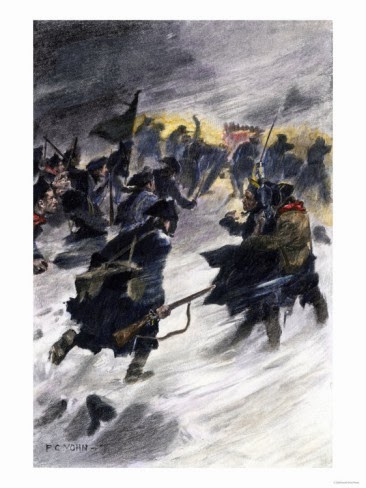
Patriot retreating from Quebec
In the time spanning more than a year, little had happened in the sense of a real military conflict, small skirmishes occurred in the Carolinas between Loyalists and Patriots and an offensive in Canada was launched. Major outcomes of the period were that Washington was appointed Commander-in-Chief and Benedict Arnold failed in his attempt to capture Quebec.
The winter of 1775 to 1776 was one of the most precarious for the war effort. Washington's ranks had swelled to over 10,000 regulars and militia, but this amount of men brought on terrible issues with logistics and management. The troops needed shelter, clothes, food and medical treatment, all of which were in short supply, but most of all, they needed training. Washington knew he could not rely on providence to save him and he quickly set to the task of whipping his men into shape.

One of the largest issues that plagued the army was venereal disease. The oldest profession had found a soft spot in the hearts and wallets of the patriot soldiers and when the men shared, they shared everything. Lets be honest though...who isn't excited by woman who shows a little ankle eh? Syphilis, Gonorrhea and Herpes ran rampant  and the surgeons, doctors and other medical staff were busy helping men with more serious ailments, cholera, trench-foot, lyme disease, typhoid, tuberculosis and a whole host of other ailments that come from packing men in close proximity with poor food and water.

Sanitation was an even bigger issue. Men would relieve themselves in close proximity to potable water sources, near the kitchens and generally wherever they could. Washington had his hands full. The first order of business was to straighten up the camp.Washington devised a plan that would solve all the issues of the camp. First and foremost - any man found with an STD would pay a fine for his medical care. On top of this, he would be required to work latrine duty until the condition cleared up. Any man caught with a prostitute in camp would be fined and forced to work the kitchens or laundry. Any man caught relieving himself in any other location than the latrine would be flogged publicly and made to work latrine duty for a week. This solved all the major issues as the money brought in from fees and fines was sufficient to help equip and feed the army. Health improved as would be expected.

Morale was further boosted by a little pamphlet called "Common Sense" by Thomas Paine. The little pamphlet summed up in plain language the patriot's reason for fighting and united the cause. With healthy soldiers and improved morale, Washington and the cause of liberty moved on toward freedom.

Friday, October 25, 2013

"I would that we could have sold them two more hills at such a cost!"

The wooden breastwork
Ammunition was low, the men were exhausted and the heat of that muggy June took its toll on the men who had spent the last twelve hours digging a dirt barricade between them and the British Red Coats. The redoubt was high and gave the men extraordinary cover, the wooden barricade extension they had thrown up gave them cover on their flank leaving not but empty ground, marsh, sand and grass between the battle lines, something that the British would learn to hate.

British Doctrine dictated that battle lines were to advance to within range of their muskets, present arms, fire and then, if the enemy lines were weak enough, present a charge with bayonet to finish off the will of the enemy. In countless battles in numberless countries this formula had paid large dividends against make-shift armies and rabble. Doubtless, this time tested tactic should work here and at 3pm the British tested the theory.The main British force was to form up at the center and advance in glorious fashion toward rebel right flank. The Line of Foot regiments were to engage the rebels at the weakest point in the line, attempt to crack them and turn the flank to envelop the remaining force in the great redoubt. The British Light infantry were sent in first to engage John Stark and his small band of men who held the extreme left on the rebel flank. These men would be counted as the heroes of the day.
The Redoubt

The pum-pararum-pum-pum of drums drowned out the chirping of crickets and the shrill cries of the piccolos cut through the muggy air as the British Light infantry formed up for their attack. They advanced at the double, moving quickly into formation. Theirs was a precarious task, the rebel redoubt on their left, and not but a sandy beach on their right. They were penned in and manouvering would not be east as the men packed in tight formation to advance.

First Attack
Knowing the range of his weapons, Stark had left stacks of painted rocks to mark ranges and as the British advanced into the perfect range, he bellowed the blessed words of battle: "FIRE!" Smoke, fire and lead filled the air as the tightly packed red coats came into range. Where twenty men had been, less than eight now remained in broken lines. Before the British had even formed ranks to fire, their had been cut nearly in half. The main attack advanced blindly in front of the redoubt, drawing sniper fire from the rooftops of Charleston and direct fire from the defenders of the earthworks. Quickly the advance turned into total chaos as officers and men fell in bloody heaps one atop the other under the withering fire of the rebels. British command watched in complete shock as some of their best men were obliterated with almost miraculous accuracy under the defensive fire from the rebels.

Charge of the Grenadiers
Second Attack
A second attack was to break the rebels once and for all. There was no way the rebels could withstand a full frontal assault.With most of their ammunition gone the command was issued down the rebel ranks to hold fire "...until you see the whites of their eyes". This popular quote carries a great weight when you figure that the whites of a person's eyes are only visible at a range of less than thirty yards. Most engagements of the time took place at the 100-140 yard range. This meant that the rebels would hold fire until the British were almost on top of them. The British formed their Grenadiers at the center. They marched boldly, bayonets charged and didn't stop to fire. When the rebels opened fire their ranks were reduced by a full three quarters. The grenadiers fell back completely decimated.

Final Attack
The third assault formed up with the remnants of all the regiments. Again they marched boldly over the same ground, now littered with the dead and dying of the previous brilliant plan. The rebels again held their fire, but, having expended most of their ammunition in the previous two engagements, the rebels were unable to stop the advance. The terrified rebel line melted away, running for their lives as the British poured over the walls of the redoubt, an ominous red wave crashing down on the battle weary defenders.

When the smoke cleared and the sides counted their dead, the rebels had 115 dead and 300 wounded. The Crown suffered 226 killed in service to the King with another 828 wounded. The Rebels had been driven from the field, but the severe loss of some of the Crown's finest troops would serve to haunt the British in later campaigns.

When Nathaniel Greene, one of Washington's closest generals, heard of the battle he said "I would that we could have sold them two more hills at such a cost!"

Friday, October 18, 2013

I said Bunker you fool! Bunker, not Breeds!

The revolution was off to a shaky start. The fate of a nation walked on legs as stable as a newborn horse and the slightest mis-step would send thousands back into subjugation beneath the British Crown. The British had been defeated at Lexington, though the victory meant little considering the British still occupied the whole of Boston Harbor and Proper. The Rebels needed a sound victory if they were going to establish their cause as a right and just one. They would get their first chance on a small peninsula overlooking Boston Harbor, a place called Breeds Hill.
Bunker and Breed's Hill

 The peninsula served little importance from a tactical standpoint but for the fact that the two hills, Breed's and Bunker, overlooked Charleston and the rest of Boston Harbor. Rebel artillery could easilly be placed on those hills and pose a great threat to the British ships who held Boston in an economic choke-hold. It was for this reason and out of hope for redemption that Gage chose to engage the Rebel forces there. On the 16th of June, elements of rebel militia under numerous commanders began marching into the peninsula, a gutsy move as a landing force would easilly trap them on the thin neck of land were they to land in the flanks.

the Redoubt at Breed's Hill
Original orders were to have the men set up defensive positions on Bunker hill, the hill closest to the narrow neck of land that would allow the rebels to withdraw should the British attempt to flank and block them in the peninsula. To say that there were miscommunications would be a generous understatement. New York officers sent orders to New Hampshire troops and Connecticut militia received orders from officers from Massachusetts. In the end, the men ended up at the smaller of the hills and began their preparations. Their numbers stated at nearly 3,000 men from varying places. They dug all night, throwing up earth to make a rampart (redoubt) with a wooden breastwork to protect from any advancing enemy.
HMS Somerset

Long into the night the men toiled with little sleep, less food and even less water. They were exhausted, but they had done it. The sight to which the British awoke on the morning of the 17th alarmed the British high command. Over night the rebels had thrown up what appeared to be an insurmountable fortification. The first order of the day was "FIRE!"

Asa Pollard Memorial, Billerica MA
The command, bellowed from the lungs of the surely gunnery mates aboard the HMS Somerset set match to fuse and the cannons belched their brimstone, fire and damnation upon the unsuspecting rebels. The first round did little in the way of actual physical damage, but the headless form of Asa Pollard served as a gory foreshadowing of what the rebels were about to face. The man was quickly interred and the rebels went on with their preparations. Men began to desert to behind the lines; fatigue, thirst and fear driving them far from the almost certain clash to come.

The next six hours would be the most tense of those men's lives as the British formed on the opposite shore and began their ferry trip to their staging grounds near the base of Breed's hill.

Friday, October 11, 2013

To the victor - The spoils

Ft. Ticonderoga as seen from Mount Defiance
With a commission from Congress, the enthusiastic and patriotic Arnold began his trip north toward Ticonderoga. He stopped in as many towns as he could trying to drum up enlistees for the attack on the British Arsenal. His hopes were to attract enough men to be a formidable force once the fort was taken and that he would retain his commission as their Brigadier General for the rest of the war. Arnolds hopes were high and his zeal for the patriot cause was only to be rivaled by that of General George Washington. Arnold found gathering recruits difficult, however, as many of the towns and cities stopped in had already sent many men to join up with the newly appointed Commander-in-Chief.


En route to Ticonderoga, Arnold received a bit of discouraging news. He was to be joined by another commander, the famous Ethan Allen. Arnold would no longer be the Brigadier to his recruits but would be co-commander of any troops raised. In truth, Allen was more veteran in both experience and rank. Allen had been fighting for years in the Vermont-New York Grants war where Allen had lead the Green Mountain Boys, a crack unit of some of the harshest and crudest mountain-men patriots the fledgling US had to offer. These men had grown up in the back woods, making their living as trappers, hunters, loggers and farmers. They were used to the territory and most had weapons that had been tested in combat against the encroaching New Yorkers. They now served the US but more importantly, they served Allen.
Flag of the Green Mountain Boys Militia

To add insult to injury, Arnold, who had hoped to recruit 400 men, arrived with himself and two other men who had set out with him. They joined ranks with Allen and a little over 100 Green Mountain Militia. Allen became the default leader of the group and Arnold knew it.

After preliminary scouting, Allen found out that the fort was garrisoned by only a handful of troops whose powder had been ruined by the heavy rainfall and whose ammunition had dwindled to shockingly low levels. He was also able to gather inteligence that the British were to be reinforced any day by a force of unknown size. The time to act was upon them. he two leaders laid out plans to assault the fort. Arnold suggested a bold attack, but was quickly countermanded by Allen who dismissed Arnold's ideas as foolish and glory seeking. They settled on their best strategy, a sneak attack on the garrison at three points along the fort.

Modern view of Ticonderoga
The plan was exicuted almost perfectly. The attack was launched mid-day just after tea time when the garrison was in the process of winding down for the day, relaxing and getting ready to change the guard. The militia poured over the walls of the fort and captured it in a bold stroke aided partly by briliant planning and partly by blind dumb luck. Upon seeing the commosion, the British commander of the fort called out "By whose authority do you enter this fort?!" to which Allen replied "In the name of the Great Jehovah and the Continental Congress!"

Within minutes the fort had been taken without a shot fired. The only recorded casualty was a slight wound suffered by an american who had tried to wrest a rifle from one of the sentries on guard duty. Quickly the fort filled with over 400 men who began looting and pilfering anything that was not bolted down. Arnold tried to stop it all and when he saw that he could not, he retired to the captain's quarters and began to write his action report. Allen, who was now seeing to the transportation of the over 30 artillery pieces entered the quarters and inquired as to the nature of the document at which Arnold was feverishly writing. When the reply came that it was an action report, Allen snatched the page, glanced over it and burned it in the fireplace declaring that it was his right, as commanding officer to detail the actions of the day. It is no doubt then, to see why Allen was hailed as the hero of Ticonderoga and Arnold was largely marginalized in the dispatches back to Congress.

This would not be the last time Arnold would be snubbed where credit was due.

Friday, October 4, 2013

Off on the wrong foot

Less than a month after the astounding victory at Lexington and Concord, the fledgling government of the Rebellious States of America found themselves faced with the painful realization that the road to independence would not be paved with hopes and good intentions. Rather that road would be one much like the British took from Concord back to Lexington, one fraught with chaos, casualties, loss depression. The truth of the matter was that this haphazard gaggle of militia, rebels and patriots was engaged in a war against the super power of its day - Britain.

The saying was that the sun never set on the British Empire and the British lived up to the Latin proverb of "Empires are not kept through timidity". Their soldiers had fought hard for years to carve out their empire at the point of sword, spear bayonet and by the flash of musket, cannon and horse hoof.
It was this ugly realization that aroused the new continental congress in the days following Lexington. They ordered a full accounting of all available stores, munitions, guns, powder, cannon and wagons. They found themselves severely wanting in all regards. Ammunition, powder and guns would be easy to come by as most of the men who had already volunteered would bring their own weapons, and what the men would not supply, the continental government would contract from some of the best gunsmiths in the world - the Quakers whose fabrication and rifling technique was begining to be duplicated in the southern colonies, could fabricate. The terrain was unforgiving to the use of cavalry who relied on large open spaces to maneuver into the flanks of the enemy, thus leaving only one issue - cannons.

Cannons were vital to any siege or defense of a city as cannons could fire heated shot* into blockading ships. They were also effective at long range engagements of tightly packed troops, the common formation of the day. The issue was that when the Americans tallied the total number of artillery in their possession, they found less than twenty pieces and only five of which were larger caliber than a 4pound gun**. 

Fort Ticonderoga
Something had to be done and the best solution is often the simplest. What do you do when you don't have something and don't have an easy way to get it? Find someone that does have it and take it from them. That someone just happened to be the British. The were the best soldiers and they knew it. This air of superiority served to be their arrogant downfall. Just across the border from modern day Vermont was a fort called Ticonderoga. The fort served as an arsenal and housed over thirty pieces of heavy artillery. The best part of the situation was that there were more cannons defending the fort than there were Red Coats.

Benedict Arnold
Ethan Allen
Congress had its desired target, all it needed was a leader for the attack and the men to carry it out. Congress appointed a young officer whose only desire was to gain fame and glory in the revolution - Benedict Arnold. Arnold was to go north and gather as many volunteers as he could, attack the fort and bring back the much needed guns to aid in the siege of Boston. Congress, however, like any true gambler, chose to hedge its bets. Why send one man with a mission when you can send two? Enter Ethan Allen - the rough-neck backwoods hero of the Hampshire Grants and veteran of the New York/Vermont boundary war and leader of the Green Mountain Boys.


Join us next week as we find how the Patriot started down the path to infamy and how the Backwoods hick became a hero.

*Heated shot was an ammunition type where gun crews would put the cannon ball into a furnace and heat it till it glowed read. The shot was then loaded into the cannon which was quickly fired at an enemy ship. The glowing shot would act as a tracer round and when it struck the ship that was highly sealed with pine tar and coated in oil to keep the wood from rotting, the round would explode into firey fragments that would send the ship up like a torch. This tactic was only employed by gun crews on the ground as no ship commander would be silly enough to allow a red hot glowing ball of death to have the possibility of slipping out of a crewman's control and rolling around a crowded gun deck.

** Cannon gun calibers were designated by the weight of the shot it fired. A 3# gun fired a cannon ball that weighted 3 pounds. A 6# gun fired a 6 pound shot and so on. While this may not seem like a large difference, the weight of the shot determined the distance the round could accurately be fired and the destructive capability the round would have when it arrived at its target. To paint the contrast, Americans were dealing with 3-6 pound guns where the British had whole batteries of 6 pound, 12 pound and 24 pound guns. To say that the Americans were out gunned would be an apropos pun.